Both do the same job
Composite panel and fluted aluminium roofing both give you permanent, solid overhead cover. Both shed rain, both take the overhead sun, both span a normal patio or carport without a mid post if the frame is set out properly.
If you are choosing between them on performance you will go round in circles, because on shelter they are equivalent. Choose on how the finished roof looks and on budget.
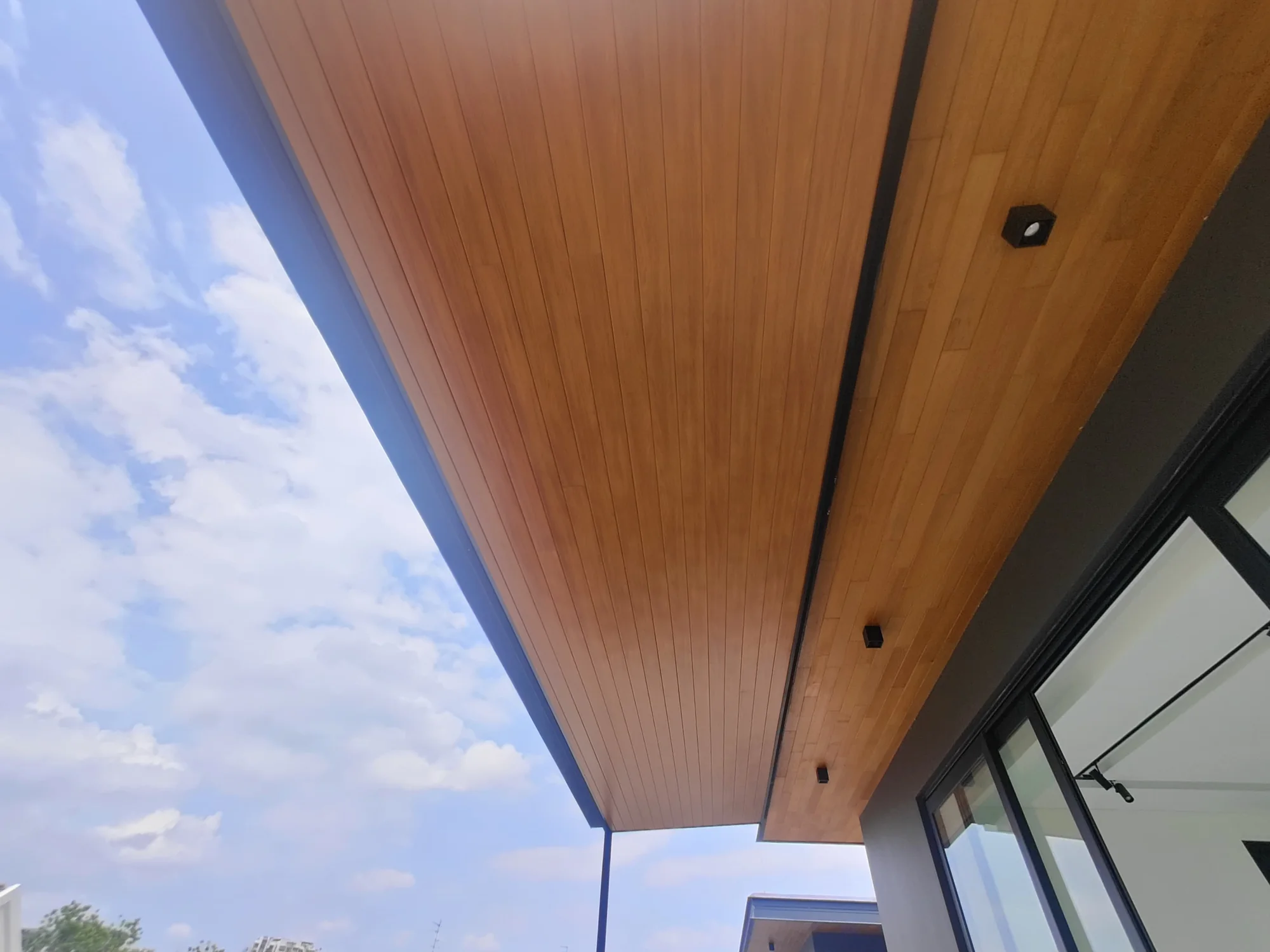
Composite panel reads as a ceiling
A composite panel roof is flat underneath. Panels run the full span, so what you see from below is one continuous plane rather than a row of sheets. Fixings are not exposed. Fan mounts and downlights are set out before the panels go up and sit flush in the surface.
That flat plane is the reason people pick it. It reads as a ceiling rather than as a shelter, which is what you want when the space is an extension of the room behind it. It is also the sharpest budget of the roofing systems we install.
The trade is that it is quiet. A flat plane does not draw attention, and if you wanted the roof to be a feature of the elevation it will not do that for you.
Fluted reads as architecture
Fluted panels are profiled, so the roof is a run of ribs. In sun those ribs throw a shadow line across the whole span and the roof becomes part of how the building looks rather than something added to it.
It sits naturally alongside fluted screens and slatted timber-look joinery, which is why it turns up on newer landed builds where that language is already on the facade.
The trade is cost and quietness. A profiled panel is a stronger visual statement, and if the rest of your exterior is calm it can be the loudest thing on it.
The third option people forget
If you cannot decide because you want cover sometimes and open sky at other times, neither fixed roof is your answer. A louvre roof rotates on a motorised spine, so the same structure gives you an open courtyard when the weather is good and a dry room when it is not.
It costs more than either fixed roof and it has moving parts and a motor to maintain. Worth it when the space is a room you actually live in, hard to justify on a drying yard.
What decides it on a real job
Look up at the eave line of your house and ask what the roof will sit next to. If the facade is flat render and calm, a flat panel roof disappears into it correctly. If the facade already has ribs, slats or fluted screens, a fluted roof continues the line and a flat one interrupts it.
Then look at the underside. If you will be standing under this thing every evening, the ceiling finish matters more than the top surface does, and that is an argument for composite panel.
Send us a photo of the space and the elevation. We will tell you which one we would put there and why, including when the answer is the cheaper one.